

Practical Leadership Micro-Change: Make One-on-One Meetings Count
Build trust and learn what matters to your team members.
by Janet Ply, PhD · The Practical Leadership Newsletter · May 26, 2026
In the last issue of Practical Leadership Microchanges, we talked about how small leadership behaviors compound over time. Great leadership is rarely the result of dramatic breakthroughs or an overnight transformation. More often, it’s the result of small behaviors repeated consistently over time.
As Jim Rohn says: “Success is nothing more than a few simple disciplines, practiced every day.”
That’s one of the most important realities in leadership. Most leadership reputations on repeated daily interactions and improvements, not one big thing. If you pick just one micro-change at a time to double-down on, over time, the results will be massive.
The micro-change we’re going to focus on in this newsletter is one-on-one meetings.
The Cost of Canceling One-on-Ones
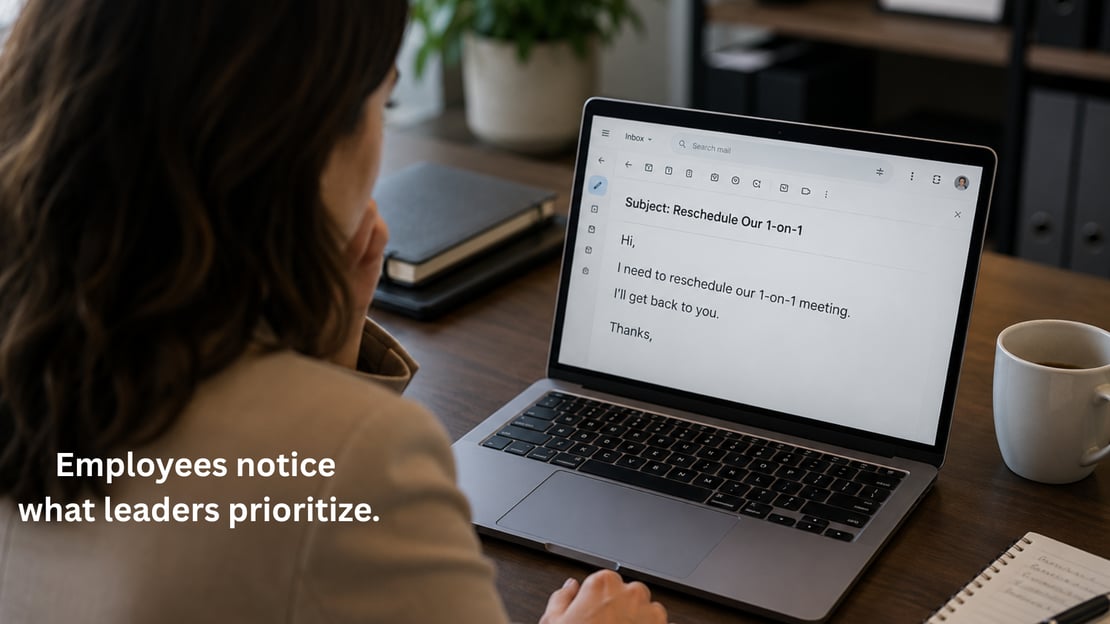
In many companies where I’ve worked or consulted, one-on-one meetings weren’t taken seriously. Many of the people in my coaching work share that they haven’t had a one-on-one meeting with their manager in months. Some simply don’t have them at all, while others say this meeting is the first one to get rescheduled.
This sends a terrible message to the employee:
- I’m not valued or respected
- I’m not seen
- My development isn’t important
The ripple effect of this behavior is far-reaching. Employees who don’t feel valued, respected, seen, and appreciated eventually start to disengage. Productivity begins to drop, morale decreases, and trust goes by the wayside over time.
Leaders often think people leave because of workload or compensation. More often, people leave because they feel consistently unseen or unappreciated.
One-on-Ones are Trust-Building Meetings
Leaders have a great opportunity when it comes to one-on-one meetings with their direct reports. These meetings are not status update meetings but rather, meetings where trust and culture are built, coaching occurs, and development plans are put into place and accountability is reinforced.
Small moments compound. A prepared leader sends signals:
- You matter
- This meeting matters
- Your development matters
When leaders consistently show up late, distracted, unprepared, or repeatedly reschedule meetings, employees notice. On the other hand, leaders who are prepared, present, and engaged build trust through small actions that often seem insignificant in the moment but become very significant over time.
Simple Ways to Improve Your One-on-Ones
Here are several simple things leaders can do to improve one-on-one meetings immediately:
- Make one-on-one meetings a priority and only reschedule as a last resort
- Spend 5-10 minutes preparing before the meeting
- Review action items from the last meeting - especially your own
- Write down several coaching questions in advance (see AI prompt below)
- Eliminate distractions by putting your phone away, closing unneeded computer windows, and turning off notifications
- Be there two minutes early
In my book, Practical Leadership, I describe what one-on-one meetings are (and aren’t) and provide sample questions leaders can use when meeting with their direct reports. You can pick up a copy at:
https://www.amazon.com/Practical-Leadership-Building-Getting-Changing-ebook/dp/B0FMKKW28C
How AI Can Help
A practical use of AI prompts during my workshops is helping leaders prepare for one-on-one meetings.
Here’s a simple AI prompt you can use to help make your one-on-ones better.
“Generate 10 coaching questions for an employee who wants to develop their leadership skills.”
In my workshops, we go into much more prompt detail to ensure that leaders are well-prepared for meetings of all types, especially one-on-ones.
Leadership Micro-Changes Compound
The best leaders aren’t usually doing one big thing differently. They’re doing small things consistently better, and over time, the results compound.
Trust compounds. Accountability compounds. Clarity compounds. Execution compounds. Culture compounds.
Leadership is often less about dramatic breakthroughs and more about repeated behaviors that quietly shape how teams operate. It’s doing the mundane. It’s putting in the reps.
Practical Leadership Micro Change Challenge
This week, choose a one-on-one meeting and intentionally make it better. Prepare beforehand, be fully present, ask better questions, and listen more carefully.
Remember, leadership micro-changes compound. Being prepared for one-on-one meetings is one of the highest-leverage leadership habits for building trust and creating a great team culture.
Next week in The Practical Leadership Micro-Changes series, I’ll share another small leadership behavior that creates big long-term results.
If you like this micro-change, you can find many more ideas in my award-winning book, Practical Leadership: A Guide to Building Trust, Getting Results, and Changing Lives. You can get a copy on Amazon or your local bookstore.
Mel Robbins, New York Times bestselling author and host of the Mel Robbins podcast had this praise for the book, “Janet Ply is the real deal. I’ve seen way too many talented people flail in leadership because nobody ever taught them how to do the job well. This book fixes that. Janet has been in the fire, she’s led through chaos, and now she’s giving you the tools she’s used to rescue high-stakes, high-dollar messes. If you lead people - or you want to - Practical Leadership should live on your desk. Get it, use it, lead better.”
Order it on Amazon or your favorite local bookstore.